2026.7.18
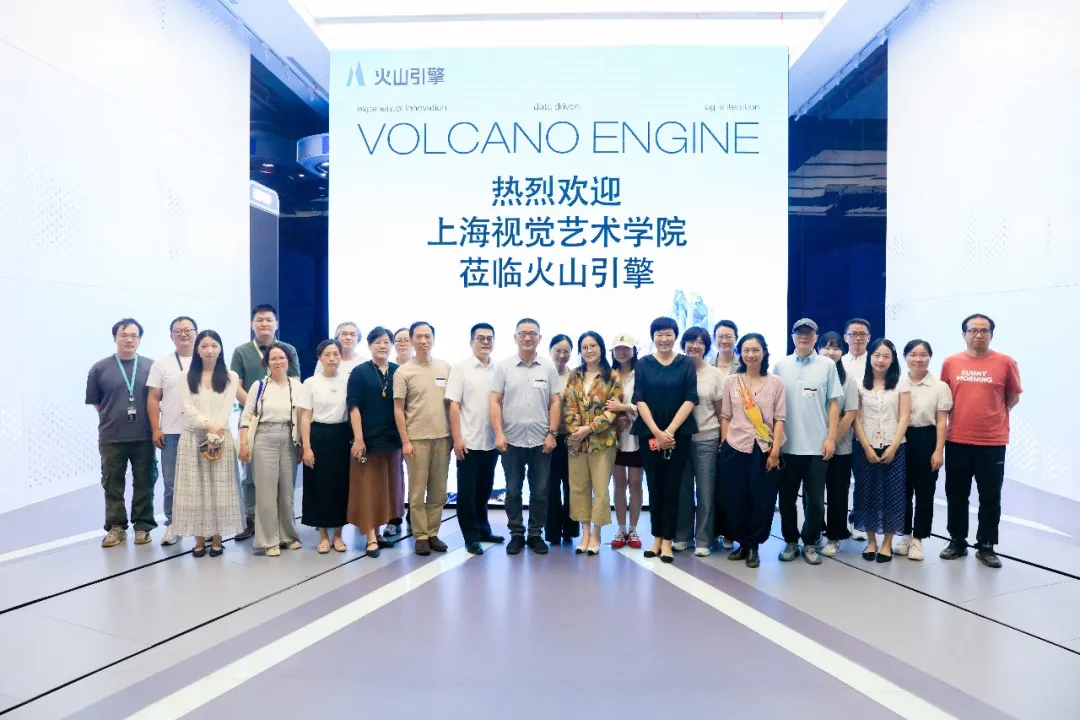
On the afternoon of July 16, to seize strategic opportunities in AI industry growth, advance digital transformation in education, and deepen industry-academia integration in "AI + Art," Yu Zhenwei, Deputy Party Secretary and Secretary of the Commission for Discipline Inspection of Shanghai Institute of Visual Arts (SIVA), together with Vice President Tang Jiejing, led a delegation to the Volcano Engine Yangpu New Jiangwan Park for an in-depth corporate exchange. The delegation included heads of the Academic Affairs Office, various secondary colleges, functional departments, and faculty members from the Academic Affairs Office. Li Jie, Head of Volcano Engine Shanghai Region, Feng Limin, Education Director for East China, and a team of industry experts hosted the delegation.
Symposium First: Exploring AI Integration Pathways for Art Institutions
Upon arrival, both parties held a specialized symposium. The Volcano Engine team shared insights regarding Volcano Engine’s technology layout, the multimodal capabilities of the Doubao Large Model, and nationwide industry-academia implementation practices. Leveraging ByteDance’s self-developed full-stack AI foundation, Volcano Engine highlights three core advantages: video generation, professional creative platforms, and real-world commercial order resources. The team analyzed common pain points across art institutions—such as fragmented AI tools, difficulty in preserving practical training outcomes, and obstacles in bringing commercial projects onto campuses—and presented benchmark collaboration cases with institutions like Tongji University, China Academy of Art, and Sichuan Media University.
Deans and department heads from SIVA outlined their teaching and operational needs:
The Academic Affairs Office sought solutions for practical training gaps in large-class AI general education courses and requested stratified teaching strategies for art majors.
Representatives from the School of Future Design and the School of Drama, Music, and Dance noted that students exhibit varying levels of proficiency in using AI tools. Highlighting market demand for interdisciplinary talent equipped with both artistic aesthetics and practical AI skills, they proposed co-building training workshops, micro-majors, and internship pathways.
School leadership, emphasizing SIVA's strength as the institution with the most comprehensive range of art disciplines in Shanghai, proposed co-founding an AI Industry College and launching tailored projects in digital media, digital fashion, and traditional culture digitization.
Yu Zhenwei commended Volcano Engine for its cutting-edge AI technologies and mature industry-academia models. He noted that AI is not a replacement for artistic creation, but a transformative medium that expands creative expression and reinvents educational models. SIVA's comprehensive art discipline chain aligns naturally with Volcano Engine's digital cultural and creative industry ecosystem, establishing a solid foundation for deep cooperation. He outlined three major collaboration initiatives:
Co-building a Specialized AI General Curriculum System: Introducing battle-tested corporate courses and industry mentors to provide stratified AI literacy training for faculty and students, addressing gaps in classroom practical skills.
Co-establishing a Campus-level AI Art Industry College: Deploying dedicated AIGC practical training platforms and bringing in real commercial orders from short dramas, e-commerce marketing, and cultural tourism IPs to deliver integrated, real-world project training.
Developing Art-focused AI Innovation Projects: Creating joint training programs centered on digital design, film and television creation, and traditional culture digitization, while opening internship and job placement pipelines to boost students' competitive edge in the market.
Responding on behalf of Volcano Engine, Li Jie stated that the company will fully open its computing power, AI models, creative tools, and industry resources to customize a cooperation plan for SIVA. The implementation will proceed across four key modules—curriculum co-construction, campus AI agents, an industry college, and employment training—aiming to build a benchmark for AI industry-academia integration among art institutions in East China. Both parties established a communication group on-site to outline collaboration deliverables and finalize execution details.
Exhibition Hall Tour: Hands-on Experience with Frontier AIGC Technologies
Following the meeting, the SIVA delegation visited Volcano Engine’s Digital Creativity Exhibition Hall. Instructors demonstrated proprietary technologies, including the Doubao Large Model, cinematic video generation, Image 2.5 Pro, AI audio, and multimodal intelligent agents. Live demonstrations showcased 30-second coherent video generation, fine light-and-shadow camera movement rendering, fine-tuning of traditional Chinese style models, end-to-end industrial production of short dramas, and AI educational material generation. The tour highlighted real-world cases relevant to SIVA’s drama and design majors, such as traditional Chinese painting digitization and cultural tourism IP revitalization in partnership with China Academy of Art.
Faculty members engaged with technical staff on teaching practices, creative implementation, and resource archiving, reaching a clear consensus on industry trends: while AI lowers technical barriers for creation, humanistic aesthetics, narrative creativity, and artistic perception will remain the core competitiveness of art students.
Deepening Industry-Academia Integration: A New Journey in Digital Art Education
Through this deep engagement with a leading AI enterprise, SIVA has clarified its roadmap for art education reform, training base construction, and interdisciplinary talent development in the AI era. Moving forward, leveraging its comprehensive artistic disciplines and combining Volcano Engine's technology and industrial resources, SIVA plans to explore restructuring the "AI + Art" curriculum system, build campus AIGC training hubs, import real-world commercial projects, and empower artistic innovation with technology. This initiative aims to meet the digital creative industry's demand for high-caliber talent, cultivate interdisciplinary professionals suited for new quality productive forces, and advance the university's high-quality, connotation-based development.
Original Article:
Author:
上海艺术学院-党委宣传部

